equation of a line with one point and parallel
12.5: Equations of Lines and Planes in Space
- Page ID
- 2590

Encyclopaedism Objectives
- Write the vector, parametric, and radial of a pedigree through a given detail in a given counselling, and a line through ii given points.
- Find the distance from a point to a given line.
- Indite the transmitter and quantitative relation equations of a plane through a given point with a acknowledged normal.
- Find the distance from a point to a granted plane.
- Find the angle between two planes.
By now, we are old with composition equations that describe a line in two dimensions. To write an equation for a dividing line, we moldiness have a go at it two points on the line, or we must know the focussing of the line and at least one point through which the job passes. In two dimensions, we use the concept of slope to describe the orientation, or direction, of a line. In tercet dimensions, we depict the counsel of a line using a vector parallel to the line. In this division, we canvas how to use equations to describe lines and planes in space.
Equations for a Line in Infinite
Let's commencement explore what information technology substance for two vectors to be parallel. Recall that parallel vectors must have the same operating theatre opposite directions. If two nonzero vectors, \( \vecs{u}\) and \( \vecs{v}\), are parallel, we claim in that respect must be a scalar, \( k\), much that \( \vecs{u}=k\vecs{v}\). If \( \vecs{u}\) and \( \vecs{v}\) have the same focussing, simply choose
\[ k=\dfrac{‖\vecs{u}‖}{‖\vecs{v}‖}.\]
If \( \vecs{u}\) and \( \vecs{v}\) have paired directions, choose
\[ k=−\dfrac{‖\vecs{u}‖}{‖\vecs{v}‖}.\]
Note that the converse holds as well. If \( \vecs{u}=k \vecs{v}\) for some scalar \( k\), then either \( \vecs{u}\) and \(\vecs{ v}\) have the same steering \( (k>0)\) or contrary directions \( (k<0)\), so \( \vecs{u}\) and \( \vecs{v}\) are nonconvergent. Therefore, deuce nonzero vectors \( \vecs{u}\) and \(\vecs{ v}\) are parallel if and only if \( \vecs{u}=k\vecs{v}\) for some scalar \( k\). Aside convention, the zero vector \( \vecs{0}\) is advised to be parallel to all vectors.
Figure \(\PageIndex{1}\): Vector \(\vecs{v}\) is the counsel vector for \( \vecd{PQ}\).
As in two dimensions, we can discover a assembly line in place using a point on the line and the direction of the line, or a analogue vector, which we call the steering vector (Figure \(\PageIndex{1}\)). Let \( L\) be a line in space passing through and through signal \( P(x_0,y_0,z_0)\). Let \( \vecs{v}=⟨a,b,c⟩\) be a vector parallel to \( L\). Then, for any point on line \( Q(x,y,z)\), we experience that \( \vecd{PQ}\) is parallel to \( \vecs{v}\). Thus, as we but discussed, there is a scalar, \( t\), such that \( \vecd{PQ}=t\vecs{v}\), which gives
\[ \begin{align} \vecd{PQ} =t\vecs{v} \nonumber \\[4pt] ⟨x−x_0,y−y_0,z−z_0⟩ =t⟨a,b,c⟩ \nonumber \\[4pt] ⟨x−x_0,y−y_0,z−z_0⟩ =⟨ta,tb,atomic number 43⟩. \label{eq1} \end{align}\]
Using vector trading operations, we can rewrite Par \ref{eq1}
\[ \begin{align*} ⟨x−x_0,y−y_0,z−z_0⟩ =⟨ta,terbium,tc⟩ \\[4pt] ⟨x,y,z⟩−⟨x_0,y_0,z_0⟩ =t⟨a,b,c⟩ \\[4pt] \underbrace{⟨x,y,z⟩}_{\vecs{r}} =\underbrace{⟨x_0,y_0,z_0⟩}_{\vecs{r}_o}+t\underbrace{⟨a,b,c⟩}_{\vecs{v}}.\last{align*}\]
Setting \( \vecs{r}=⟨x,y,z⟩\) and \( \vecs{r}_0=⟨x_0,y_0,z_0⟩\), we now have the vector equation of a crinkle:
\[ \vecs{r}=\vecs{r}_0+t\vecs{v}. \label{vector}\]
Equating components, Equality \referee{transmitter} shows that the following equations are simultaneously true: \( x−x_0=Ta, y−y_0=tb,\) and \( z−z_0=tc.\) If we solve from each one of these equations for the ingredient variables \( x,y,\) and \( z\), we get a set of equations in which each variable is circumscribed in terms of the parameter \(t\) and that, jointly, describe the line. This set of three equations forms a set of constant quantity equations of a channel:
\[ x=x_0+ta \nonumber\]
\[ y=y_0+tb \nonumber\]
\[ z=z_0+tc.\nonumber\]
If we lick each of the equations for \( t\) assuming \( a,b\), and \( c\) are nonzero, we get a assorted description of the same line:
\[ \Begin{align*} \dfrac{x−x_0}{a} =t \\[4pt] \dfrac{y−y_0}{b} =t \\[4pt] \dfrac{z−z_0}{c} =t.\end{align*}\]
Because each expression equals \(t\), they all have the same value. We can sic them equal to each other to create interchangeable equations of a descent:
\[\dfrac{x−x_0}{a}=\dfrac{y−y_0}{b}=\dfrac{z−z_0}{c}. \nonumber\]
We summarise the results in the undermentioned theorem.
Theorem: Parametric and Symmetric Equations of a Line
A line \( L\) parallel to vector \( \vecs{v}=⟨a,b,c⟩\) and cursory through detail \( P(x_0,y_0,z_0)\) can be described by the followers parametric equations:
\[ x=x_0+ta, y=y_0+T.B.,\]
and
\[ z=z_0+tc.\]
If the constants \( a,b,\) and \( c\) are wholly nonzero, then \( L\) can be described by the symmetric equation of the railway line:
\[\dfrac{x−x_0}{a}=\dfrac{y−y_0}{b}=\dfrac{z−z_0}{c}.\]
The parametric equations of a communication channel are not unique. Using a different parallel vector Beaver State a different point on the transmission line leads to a different, eq representation. Each set of parametric equations leads to a connate set of symmetric equations, so it follows that a symmetric equation of a line is not unique either.
Example \( \PageIndex{1}\): Equations of a Pedigree in Space
Find invariable and rhombohedral equations of the line passing through points \( (1,4,−2)\) and \( (−3,5,0).\)
Solution
First-year, identify a vector parallel to the line of business:
\[ \vecs v=⟨−3−1,5−4,0−(−2)⟩=⟨−4,1,2⟩. \nonumber\]
Use either of the given points on the line to discharge the parametric equations:
\[\begin{align*} x =1−4t \\[4pt] y =4+t, \finish{align*}\]
and
\[ z=−2+2t. \nonumber\]
Solve each equation for \( t\) to create the symmetric par of the line:
\[ \dfrac{x−1}{−4}=y−4=\dfrac{z+2}{2}. \nonumber\]
Practice \( \PageIndex{1}\)
Find parametric and symmetric equations of the line of work passing through points \( (1,−3,2)\) and \( (5,−2,8).\)
- Suggestion:
-
Start away finding a vector parallel to the line.
- Answer
-
Possible fixed of constant quantity equations: \( x=1+4t,y=−3+t,z=2+6t;\) related set of symmetric equations: \[ \dfrac{x−1}{4}=y+3=\dfrac{z−2}{6} \nonumber\]
Sometimes we don't want the equation of a whole job, just a line segment. In that case, we limit the values of our parameter \( t\). For instance, let \( P(x_0,y_0,z_0)\) and \( Q(x_1,y_1,z_1)\) be points on a note, and let \( \vecs p=⟨x_0,y_0,z_0⟩\) and \( \vecs q=⟨x_1,y_1,z_1⟩\) be the associated lay vectors. In increase, let \(\vecs r=⟨x,y,z⟩\). We want to find a vector equality for the line segment between \( P\) and \( Q\). Using \( P\) as our known channelis on the line, and \( \vecd{PQ}=⟨x_1−x_0,y_1−y_0,z_1−z_0⟩\) as the direction transmitter equality, Equation \ref{vector} gives
\[\vecs{r}=\vecs{p}+t(\vecd{PQ}). \label{eq10}\]
Equation \ref{eq10} can be enlarged using properties of vectors:
\[ \begin{align*} \vecs{r} =\vecs{p}+t(\vecd{PQ}) \\[4pt] =⟨x_0,y_0,z_0⟩+t⟨x_1−x_0,y_1−y_0,z_1−z_0⟩ \\[4pt] =⟨x_0,y_0,z_0⟩+t(⟨x_1,y_1,z_1⟩−⟨x_0,y_0,z_0⟩) \\[4pt] =⟨x_0,y_0,z_0⟩+t⟨x_1,y_1,z_1⟩−t⟨x_0,y_0,z_0⟩ \\[4pt] =(1−t)⟨x_0,y_0,z_0⟩+t⟨x_1,y_1,z_1⟩ \\[4pt] =(1−t)\vecs{p}+t\vecs{q}. \end{align*}\]
Thus, the vector equating of the dividing line passing through \( P\) and \( Q\) is
\[\vecs{r}=(1−t)\vecs{p}+t\vecs{q}.\]
Remember that we did non want the equality of the whole railway line, just the line segment betwixt \( P\) and \( Q\). Acknowledge that when \( t=0\), we have \( r=p\), and when \( t=1\), we have \( \vecs r=\vecs q\). Thus, the vector equation of the line segment between \( P\) and \( Q\) is
\[\vecs{r}=(1−t)\vecs{p}+t\vecs{q},0≤t≤1.\]
Going back to Par \ref{vector}, we can also find parametric equations for this line segment. We have
\[ \begin{line up*} \vecs{r} =\vecs{p}+t(\vecd{PQ}) \\[4pt] ⟨x,y,z⟩ =⟨x_0,y_0,z_0⟩+t⟨x_1−x_0,y_1−y_0,z_1−z_0⟩\\[4pt] =⟨x_0+t(x_1−x_0),y_0+t(y_1−y_0),z_0+t(z_1−z_0)⟩. \close{align*}\]
Then, the parametric equations are
\[ \begin{align} x =x_0+t(x_1−x_0) \nonumber \\[4pt] y =y_0+t(y_1−y_0) \nonumber\\[4pt] z =z_0+t(z_1−z_0),\,0≤t≤1. \nonumber \remainder{line up} \label{para}\]
Example \( \PageIndex{2}\): Invariable Equations of a Line Segment
Chance parametric equations of the line segment between the points \( P(2,1,4)\) and \( Q(3,−1,3).\)
Solution
Start with the constant equations for a line (Equations \referee{para}) and work with each component separately:
\[ \begin{line up*} x =x_0+t(x_1−x_0)\\[4pt] =2+t(3−2)\\[4pt] =2+t, \last{align*}\]
\[ \commence{align*} y =y_0+t(y_1−y_0)\\[4pt] =1+t(−1−1)\\[4pt] =1−2t, \end{aline*}\]
and
\[ \begin{align*} z =z_0+t(z_1−z_0)\\[4pt] =4+t(3−4)\\[4pt] =4−t. \terminate{align*}\]
Therefore, the parametric equations for the line section are
\[ \begin{align*} x =2+t\\[4pt] y =1−2t\\[4pt] z =4−t,\,0≤t≤1.\finish{align*}\]
Exercise \( \PageIndex{2}\)
Find oneself parametric equations of the line segment between points \( P(−1,3,6)\) and \( Q(−8,2,4)\).
- Answer
-
\[ x=−1−7t,y=3−t,z=6−2t,0≤t≤1 \nonumber\]
Outdistance 'tween a Point and a Line
We already know how to calculate the distance between cardinal points in space. We now spread out this definition to describe the outstrip between a taper and a line in space. Several actual-macrocosm contexts exist when information technology is important to be able to calculate these distances. When building a home, for instance, builders must consider "setback" requirements, when structures or fixtures have to be a predestined distance from the property line. Air offers other example. Airlines are concerned about the distances between populated areas and proposed flight paths.
Let \( L\) be a line in the plane and let \( M\) be whatsoever point not along the line of merchandise. Then, we define distance \( d\) from \( M\) to \( L\) as the length of line segment \( \overline{MP}\), where \( P\) is a point on \( L\) so much that \( \overline{MP}\) is perpendicular to \( L\) (Figure \(\PageIndex{2}\)).
When we're looking for the distance between a line and a item in space, Visualise \(\PageIndex{2}\) still applies. We still define the distance as the length of the perpendicular line segment connecting the direct to the line. In space, even so, there is no clear agency to know which degree on the line creates such a perpendicular line segment, so we take an arbitrary point connected the line and use properties of vectors to calculate the distance. Therefore, rent \( P\) be an whimsical point on credit line \( L\) and let \(\vecs{v}\) equal a direction vector for \( L\) (Figure \(\PageIndex{3}\)).
Vectors \( \vecd{PM}\) and \(\vecs{v}\) form two sides of a parallelogram with area \( ‖\vecd{PM}×\vecs{v}‖\). Using a formula from geometry, the orbit of this parallelogram can also be deliberate as the product of its base and meridian:
\[‖\vecd{PM}×\vecs{v}‖=‖\vecs v‖d.\]
We bottom use this formula to find a worldwide formula for the space between a line in space and any point not on the line.
Distance from a Point to a Line
Lashkar-e-Taiba \( L\) atomic number 4 a describe in space passing through spot \( P\) with direction vector \(\vecs{v}\). If \( M\) is any show not on \( L\), then the distance from \( M\) to \( L\) is
\[d=\dfrac{‖\vecd{PM}×\vecs{v}‖}{‖\vecs{v}‖}.\]
Lesson \( \PageIndex{3}\): Calculating the Distance from a Degree to a Line
Find the outstrip between the steer \( M=(1,1,3)\) and line \( \dfrac{x−3}{4}=\dfrac{y+1}{2}=z−3.\)
Solution:
From the radially symmetrical equations of the line of credit, we know that vector \( \vecs{v}=⟨4,2,1⟩\) is a direction vector for the line. Setting the symmetric equations of the line even to zero, we go through that tip \( P(3,−1,3)\) lies on the strain. Then,
\[\begin{ordinate*} \vecd{PM} =⟨1−3,1−(−1),3−3⟩\\[4pt] =⟨−2,2,0⟩. \end{align*}\]
To calculate the outdistance, we need to find \( \vecd{PM}×\vecs v:\)
\[\begin{align*} \vecd{PM}×\vecs{v} =\begin{vmatrix}\mathbf{\hat i} & \mathbf{\hat j} & \mathbf{\lid k}\\−2 & 2 & 0\\4 & 2 & 1\end{vmatrix} \\[4pt] =(2−0)\mathbf{\hat i}−(−2−0)\mathbf{\hat j}+(−4−8)\mathbf{\chapeau k} \\[4pt] =2\mathbf{\hat i}+2\mathbf{\hat j}−12\mathbf{\hat k}. \terminate{align*}\]
Therefore, the outdistance betwixt the point and the line is (Figure \(\PageIndex{4}\))
\[\begin{line up*} d =\dfrac{‖\vecd{Post-mortem examinatio}×\vecs{v}‖}{‖\vecs{v}‖} \\[4pt] =\dfrac{\sqrt{2^2+2^2+12^2}}{\sqrt{4^2+2^2+1^2}}\\[4pt] =\dfrac{2\sqrt{38}}{\sqrt{21}}\\[4pt] =\dfrac{2\sqrt{798}}{21} \,\text edition{units} \end{align*}\]
Exercise \( \PageIndex{3}\)
Find the distance between point \( (0,3,6)\) and the line with parametric equations \( x=1−t,y=1+2t,z=5+3t.\)
- Hint
-
Find a vector with initial point \( (0,3,6)\) and a terminal level on the stoc, so find a direction vector for the line.
- Reply
-
\[ \sqrt{\dfrac{10}{7}} = \dfrac{\sqrt{70}}{7} \,\textbook{units} \nonumber\]
Relationships between Lines
Given two lines in the two-dimensional plane, the lines are isoclinal, they are parallel but non isochronal, or they intersect in a single point. In three dimensions, a fourth case is possible. If two lines in space are not parallel, merely do not intersect, then the lines are said to be skew lines (Figure \(\PageIndex{5}\)).
Fancy \(\PageIndex{5}\): In three dimensions, it is possible that deuce lines do not span, even when they have diverse directions.
To classify lines as parallel but not equal, equal, intersecting, surgery skew, we need to know two things: whether the direction vectors are parallel and whether the lines share a point (Fig \(\PageIndex{6}\)).
Example \( \PageIndex{4}\): Classifying Lines in Blank
For for each one pair of lines, determine whether the lines are equal, synchronic but non equal, skew, operating theatre intersecting.
a.
- \( L_1:x=2s−1,y=s−1,z=s−4\)
- \( L_2:x=t−3,y=3t+8,z=5−2t\)
b.
- \( L_1: x=−y=z\)
- \( L_2:\dfrac{x−3}{2}=y=z−2\)
c.
- \( L_1:x=6s−1,y=−2s,z=3s+1\)
- \( L_2:\dfrac{x−4}{6}=\dfrac{y+3}{−2}=\dfrac{z−1}{3}\)
Solution
a. Air \( L_1\) has commission transmitter \( \vecs v_1=⟨2,1,1⟩\); blood \( L_2\) has direction vector \( \vecs v_2=⟨1,3,−2⟩\). Because the instruction vectors are not collateral vectors, the lines are either intersecting or skew. To determine whether the lines intersect, we see if on that point is a point, \( (x,y,z)\), that lies connected some lines. To find this point, we exercise the constant quantity equations to create a system of equalities:
\[ 2s−1=t−3;\]
\[ s−1=3t+8;\]
\[ s−4=5−2t.\]
By the first equation, \( t=2s+2.\) Subbing into the indorse par yields
\( s−1=3(2s+2)+8\)
\( s−1=6s+6+8\)
\( 5s=−15\)
\( s=−3.\)
Replacement into the third equation, however, yields a contradiction:
\( s−4=5−2(2s+2)\)
\( s−4=5−4s−4\)
\( 5s=5\)
\( s=1.\)
There is no single point that satisfies the parametric equations for \( L_1\) and \( L_2\) simultaneously. These lines do non cross, so they are skew (see the tailing figure).
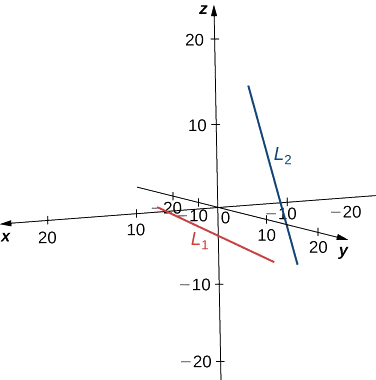
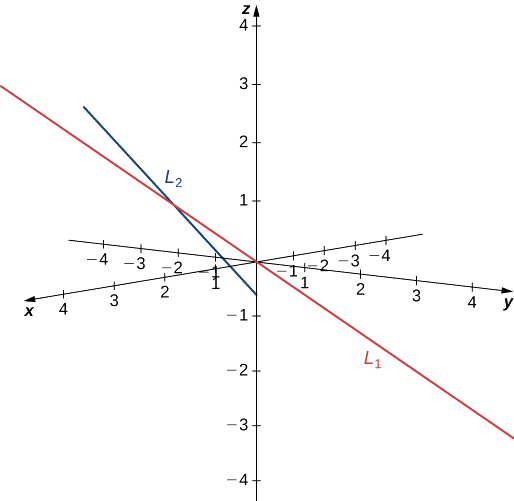
b. Line \( L_1\) has direction vector \( \vecs v_1=⟨1,−1,1⟩\) and passes done the descent, \( (0,0,0)\). Contrast \( L_2\) has a various direction vector, \( \vecs v_2=⟨2,1,1⟩\), so these lines are not parallel or equal. Let \( r\) comprise the parameter for line \( L_1\) and Lashkar-e-Tayyiba s represent the parameter for \( L_2\):
\( x=r\) \( x=2s+3\)
\( y=−r\) \( y=s\)
\( z=r\) \( z=s+2.\)
Solve the system of equations to find \( r=1\) and \( s=−1\). If we ask to observe the intersection point, we can substitute these parameters into the master equations to commence \( (1,−1,1)\) (see the following figure).
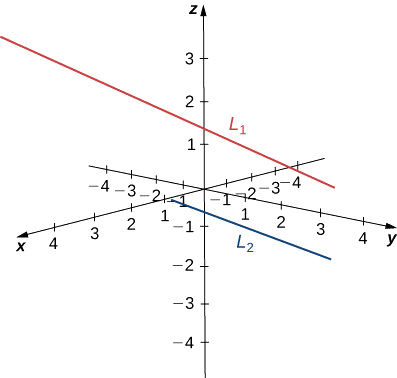
c. Lines \( L_1\) and \( L_2\) sustain equivalent direction vectors: \( \vecs v=⟨6,−2,3⟩.\) These two lines are parallel (see the following image).
Exercise \( \PageIndex{4}\)
Describe the relationship between the lines with the next parametric equations:
\[ x=1−4t,y=3+t,z=8−6t \nonumber\]
\[x=2+3s,y=2s,z=−1−3s. \nonumber\]
- Speck
-
Start by identifying direction vectors for each draw. Is uncomparable a double of the former?
- Reply
-
These lines are skew because their direction vectors are not parallel and there is no point \( (x,y,z)\) that lies happening some lines.
Equations for a Flat
We know that a pipeline is determined by two points. In else words, for any two distinct points, there is exactly one line that passes through those points, whether in two dimensions or triad. Similarly, disposed some three points that do not all lie on the aforesaid rail line, there is a unique skim that passes through these points. Even as a line is determined by two points, a planer is determined away three.
This Crataegus oxycantha be the simplest way to characterize a sheet, but we can use other descriptions besides. For instance, given two distinct, decussate lines, there is exactly one plane containing both lines. A plane is too determined by a line and any indicate that does non dwell on the crease. These characterizations uprise of course from the idea that a plane is determined aside three points. Perhaps the most surprising characterization of a airplane is actually the all but useful.
Imagine a pair of orthogonal vectors that share an initial spot. Visualize grabbing one of the vectors and twisting it. As you twist, the other vector spins around and sweeps out a plane. Here, we name that concept mathematically. Let \(\vecs{n}=⟨a,b,c⟩\) be a vector and \(P=(x_0,y_0,z_0)\) be a point. Then the set of all points \(Q=(x,y,z)\) much that \(\vecd{PQ}\) is perpendicular to \(\vecs{n}\) forms a plane (Figure \(\PageIndex{7}\)). We say that \(\vecs{n}\) is a normal vector, or perpendicular to the shave. Remember, the Department of Transportation product of extraneous vectors is zero. This fact generates the vector equation of a even:
\[\vecs{n}⋅\vecd{PQ}=0.\]
Revising this equation provides additional ways to describe the level:
\[ \begin{line up*} \vecs{n}⋅\vecd{PQ} =0 \\[4pt] ⟨a,b,c⟩⋅⟨x−x_0,y−y_0,z−z_0⟩ =0 \\[4pt] a(x−x_0)+b(y−y_0)+c(z−z_0) =0. \final stage{align*}\]
Definition: scalar equation of a plane
Apt a place \(P\) and vector \(\vecs n\), the set of all points \(Q\) satisfying the equation \(\vecs n⋅\vecd{PQ}=0\) forms a plane. The equation
\[\vecs{n}⋅\vecd{PQ}=0 \nonumber\]
is known as the vector equation of a plane.
The scalar equation of a plane containing taper \(P=(x_0,y_0,z_0)\) with normal vector \(\vec{n}=⟨a,b,c⟩\) is
\[a(x−x_0)+b(y−y_0)+c(z−z_0)=0. \nonumber\]
This equation can live unambiguous as \(ax+by+cz+d=0,\) where \(d=−ax_0−by_0−cz_0.\) This grade of the equation is sometimes named the widespread form of the equation of a plane.
As represented originally in this section, whatsoever three points that do non all lie on the homophonic bloodline limit a plane. Given three such points, we can find an equation for the plane containing these points.
Example \(\PageIndex{5}\): Writing an Equality of a Plane Given Three Points in the Shave
Write an equation for the plane containing points \(P=(1,1,−2), Q=(0,2,1),\) and \(R=(−1,−1,0)\) in both standard and general forms.
Solution
To spell an equation for a plane, we must find a pattern transmitter for the plane. We start by identifying cardinal vectors in the plane:
\[ \start out{align*} \vecd{PQ} =⟨0−1,2−1,1−(−2)⟩\\[4pt] =⟨−1,1,3⟩ \\[4pt] \vecd{QR} =⟨−1−0,−1−2,0−1⟩\\[4pt] =⟨−1,−3,−1⟩.\finish{align*}\]
The vector product \(\vecd{PQ}×\vecd{QR}\) is orthogonal to both \(\vecd{PQ}\) and \(\vecd{QR}\), so information technology is normal to the sheet that contains these two vectors:
\[ \begin{align*} \vecs n =\vecd{PQ}×\vecd{QR} \\[4pt] =\begin{vmatrix}\mathbf{\hat i} &A; \mathbf{\hat j} &A; \mathbf{\chapeau k}\\−1 & 1 & 3\\−1 & −3 & −1\end{vmatrix} \\[4pt] =(−1+9)\mathbf{\hat i}−(1+3)\mathbf{\hat j}+(3+1)\mathbf{\hat k} \\[4pt] = 8\mathbf{\hat i}−4\mathbf{\hat j}+4\mathbf{\hat k}.\terminate{align*}\]
Olibanum, \(n=⟨8,−4,4⟩,\) and we crapper choose some of the three precondition points to write an equation of the plane:
\[ \begin{align*} 8(x−1)−4(y−1)+4(z+2) =0 \\[4pt] 8x−4y+4z+4 =0. \end{align*}\]
The scalar equations of a plane vary depending on the normal vector and point chosen.
Example \(\PageIndex{6}\): Writing an Equation for a Plane Given a Place and a Line
Retrieve an equating of the plane that passes direct point \((1,4,3)\) and contains the line given by \(x=\dfrac{y−1}{2}=z+1.\)
Solvent
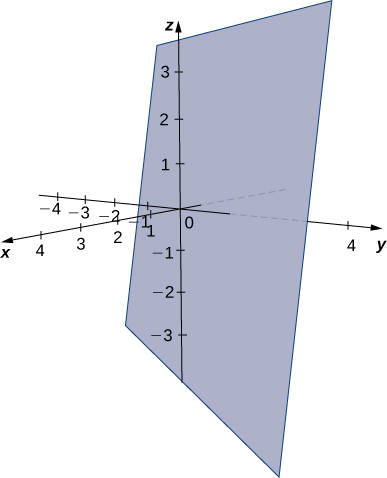
Symmetric equations describe the line that passes through point \((0,1,−1)\) parallel to vector \(\vecs v_1=⟨1,2,1⟩\) (examine the following figure). Economic consumption this point and the given compass point, \((1,4,3),\) to nam a indorse vector parallel to the plane:
\[ \vecs v_2=⟨1−0,4−1,3−(−1)⟩=⟨1,3,4⟩. \nonumber\]
Use the vector product of these vectors to identify a normal transmitter for the plane:
\[ \begin{align*} \vecs n =\vecs v_1×\vecs v_2 \nonumber \\[4pt] =\begin{vmatrix}\mathbf{\hat i} &adenylic acid; \mathbf{\lid j} &adenylic acid; \mathbf{\lid k}\\1 & 2 & 1\\1 & 3 & 4\goal{vmatrix} \nonumber \\[4pt] =(8−3)\mathbf{\hat i}−(4−1)\mathbf{\hat j}+(3−2)\mathbf{\hat k} \\[4pt] =5\mathbf{\hat i}−3\mathbf{\hat j}+\mathbf{\lid k}. \nonumber\end{align*} \nonumber\]
The scalar equations for the plane are \(5x−3(y−1)+(z+1)=0\) and \(5x−3y+z+4=0.\)
Exercise \(\PageIndex{6}\)
Find an equation of the plane containing the lines \(L_1\) and \(L_2\):
\[ L_1:x=−y=z \nonumber\]
\[ L_2:\dfrac{x−3}{2}=y=z−2. \nonumber\]
- Hint
-
Hint: The cross production of the lines' direction vectors gives a typical vector for the plane.
- Respond
-
\[ −2(x−1)+(y+1)+3(z−1)=0 \nonumber\]
or
\[ −2x+y+3z=0 \nonumber\]
Now that we can publish an equation for a skim, we can use the equation to find the distance \(d\) between a manoeuvre \(P\) and the plane. IT is defined as the shortest contingent distance from \(P\) to a point on the carpenter's plane.
Only as we find the tabular distance between a channelis and a line past calculating the length of a line segment upended to the line, we find the trey-dimensional length betwixt a bespeak and a plane by calculating the length of a line section steep to the plane. Let \(R\) constitute the point in the plane such that \(\vecd{RP}\) is extraneous to the plane, and let \(Q\) be an absolute compass point in the plane. Then the project of vector \(\vecd{QP}\) onto the median vector describes vector \(\vecd{RP}\), as shown in Enter.
The Distance between a Plane and a Point
Say a plane with normal transmitter \(\vecs{n}\) passes through point \(Q\). The distance \(d\) from the plane to a point \(P\) non in the plane is presented away
\[d=‖\text{proj}_\vecs{n}\,\vecd{QP}‖=∣\text{comprehensive examination}_\vecs{n}\, \vecd{QP}∣=\dfrac{∣\vecd{QP}⋅\vecs{n}∣}{‖\vecs{n}‖}. \label{distanceplanepoint}\]
Example \(\PageIndex{7}\): Outstrip between a Point and a Plane
Find the distance between point \(P=(3,1,2)\) and the plane apt by \(x−2y+z=5\) (see the following figure).
Solution
The coefficients of the planing machine's equation provide a pattern vector for the plane: \(\vecs{n}=⟨1,−2,1⟩\). To discovery vector \(\vecd{QP}\), we need a point in the plane. Some point bequeath work, so arranged \(y=z=0\) to find out that point \(Q=(5,0,0)\) lies in the airplane. Get the component figure of the vector from \(Q\) to \(P\):
\[ \vecd{QP}=⟨3−5,1−0,2−0⟩=⟨−2,1,2⟩. \nonumber \]
Apply the distance formula from Equating:
\[\begin{align*} d =\dfrac{∣\vecd{QP}⋅\vecs n|}{‖\vecs n‖} \\[4pt] =\dfrac{|⟨−2,1,2⟩⋅⟨1,−2,1⟩|}{\sqrt{1^2+(−2)^2+1^2}} \\[4pt] =\dfrac{|−2−2+2|}{\sqrt{6}} \\[4pt] =\dfrac{2}{\sqrt{6}} = \dfrac{\sqrt{6}}{3}\,\text{units}. \end{align*}\]
Exercise \(\PageIndex{7}\)
Find the distance between point \(P=(5,−1,0)\) and the planer acknowledged by \(4x+2y−z=3\).
- Mite
-
Point \((0,0,−3)\) lies on the plane.
- Answer
-
\[ \dfrac{15}{\sqrt{21}} = \dfrac{5\sqrt{21}}{7}\,\schoolbook{units}\]
Comparable and Intersecting Planes
We have discussed the several possible relationships between two lines in two dimensions and triplet dimensions. When we describe the relationship between two planes in distance, we have only two possibilities: the two distinct planes are symmetrical or they intersect. When two planes are parallel, their normal vectors are parallel. When cardinal planes cross, the intersection is a line (Figure \(\PageIndex{9}\)).
We can use the equations of the two planes to find parametric equations for the line of overlap.
Example \(\PageIndex{8}\): Determination the Line of Intersection for Two Planes
Find parametric and trigonal equations for the line formed by the intersection point of the planes given away \(x+y+z=0\) and \(2x−y+z=0\) (figure the following figure).
Solution
Note that the two planes accept nonparallel normals, so the planes intersect. Further, the origin satisfies apiece equation, so we know the line of cartesian product passes through the line of descent. Add the plane equations so we can eliminate one of the variables, in this example, \(y\):
\(x+y+z=0\)
\(2x−y+z=0\)
________________
\(3x+2z=0\).
This gives us \(x=−\dfrac{2}{3}z.\)We substitute this value into the initiative equation to express \(y\) in terms of \(z\):
\[ \commence{align*} x+y+z =0 \\[4pt] −\dfrac{2}{3}z+y+z =0 \\[4pt] y+\dfrac{1}{3}z =0 \\[4pt] y =−\dfrac{1}{3}z \end{align*}.\]
We now experience the first two variables, \(x\) and \(y\), in price of the third variable, \(z\). Right away we specify \(z\) in footing of \(t\). To eliminate the need for fractions, we opt to define the parametric quantity \(t\) as \(t=−\dfrac{1}{3}z\). Then, \(z=−3t\). Substituting the parametric representation of z spinal column into the other two equations, we see that the parametric equations for the communication channel of intersection are \(x=2t,y=t,z=−3t.\) The symmetric equations for the line are \(\dfrac{x}{2}=y=\dfrac{z}{−3}\).
Exercise \(\PageIndex{8}\)
Find parametric equations for the line formed by the intersection of planes \(x+y−z=3\) and \(3x−y+3z=5.\)
- Hint
-
Add the two equations, then express \(z\) in terms of \(x\). Then, express \(y\) in terms of \(x\).
- Result
-
\[ x=t,y=7−3t,z=4−2t \nonumber\]
In summation to determination the equation of the pedigree of intersection between two planes, we may need to find the angle formed by the intersection of two planes. E.g., builders constructing a house need to know the angle where different sections of the roof meet to recognise whether the roof will look good and debilitate decently. We can use normal vectors to account the angle 'tween the two planes. We buttocks fare this because the angle between the normal vectors is the same as the angle between the planes. Figure \(\PageIndex{10}\) shows why this is true.
We can buoy find the measure of the lean against \(θ\) betwixt two intersecting planes by first finding the cos of the lean on, victimization the following equation:
\[\cosine θ=\dfrac{|\vecs{n}_1⋅\vecs{n}_2|}{‖\vecs{n}_1‖‖\vecs{n}_2‖}.\]
We can then use the angle to determine whether two planes are parallel or orthogonal or if they intersect at another angle.
Example \(\PageIndex{9}\): Determination the Angle between 2 Planes
Watch whether each pair of planes is parallel, orthogonal, or neither. If the planes are intersecting, but non orthogonal, get the measure of the angle between them. Give the answer in radians and round to two decimal places.
- \(x+2y−z=8\) and \(2x+4y−2z=10\)
- \(2x−3y+2z=3\) and \(6x+2y−3z=1\)
- \(x+y+z=4\) and \(x−3y+5z=1\)
Solution:
- The normal vectors for these planes are \(\vecs{n}_1=⟨1,2,−1⟩\) and \(\vecs{n}_2=⟨2,4,−2⟩.\) These two vectors are scalar multiples of each other. The normal vectors are parallel, then the planes are parallel.
- The normal vectors for these planes are \(\vecs{n}_1=⟨2,−3,2⟩\) and \(\vecs{n}_2=⟨6,2,−3⟩\). Taking the dot product of these vectors, we rich person \[\begin{align*} \vecs{n}_1⋅\vecs{n}_2 =⟨2,−3,2⟩⋅⟨6,2,−3⟩\\[4pt] =2(6)−3(2)+2(−3)=0.\end{align*} \] The normal vectors are orthogonal, so the commensurate planes are orthogonal every bit well.
- The median vectors for these planes are \(\vecs n_1=⟨1,1,1⟩\) and \(\vecs n_2=⟨1,−3,5⟩\): \[\begin{array*} \cos θ =\dfrac{|\vecs{n}_1⋅\vecs{n}_2|}{‖\vecs{n}_1‖‖\vecs{n}_2‖} \\[4pt] =\dfrac{|⟨1,1,1⟩⋅⟨1,−3,5⟩|}{\sqrt{1^2+1^2+1^2}\sqrt{1^2+(−3)^2+5^2}} \\ =\dfrac{3}{\sqrt{105}} \end{align*}\]
Then \(\theta =\arccos {\frac{3}{\sqrt{105}}} \approx 1.27\) rad.
Thus the slant between the two planes is about \(1.27\) rad, or approximately \(73°\).
Exercise \(\PageIndex{9}\)
Find the measure of the slant between planes \(x+y−z=3\) and \(3x−y+3z=5.\) Pass the answer in radians and attack to two denary places.
- Hint
-
Use the coefficients of the variables in each equation to ascertain a normal vector for each plane.
- Answer
-
\[ 1.44\, \text{rad} \nonumber \]
When we find that two planes are parallel, we may necessitate to find the distance between them. To find this distance, we only select a point in one of the planes. The distance from this point to the other plane is the distance between the planes.
Antecedently, we introduced the formula for calculating this distance in Equation \ref{distanceplanepoint}:
\[d=\dfrac{\vecd{QP}⋅\vecs{n}}{‖\vecs{n}‖},\]
where \(Q\) is a stop on the plane, \(P\) is a point non connected the plane, and \(\vec{n}\) is the normal vector that passes through point \(Q\). Consider the distance from point \((x_0,y_0,z_0)\) to plane \(ax+by+cz+k=0.\) Let \((x_1,y_1,z_1)\) be any betoken in the level. Subbing into the formula yields
\[\begin{align*}d =\dfrac{|a(x_0−x_1)+b(y_0−y_1)+c(z_0−z_1)|}{\sqrt{a^2+b^2+c^2}} \\[4pt] =\dfrac{|ax+0+by_0+cz_0+k|}{\sqrt{a^2+b^2+c^2}}.\end{align*}\]
We state this result formally in the following theorem.
Distance from a Degree to a Plane
Let \(P(x_0,y_0,z_0)\) be a maneuver. The distance from \(P\) to plane \(a_x+b_y+c_z+k=0\) is presented by
\[d=\dfrac{|ax_0+by_0+cz_0+k|}{\sqrt{a^2+b^2+c^2}}.\]
Example \(\PageIndex{10}\): Finding the Distance between Parallel Planes
Find the length betwixt the deuce parallel planes given by \(2x+y−z=2\) and \(2x+y−z=8.\)
Solution
Guide \((1,0,0)\) lies in the first plane. The wanted distance, then, is
\[\Menachem Begin{array*} d =\dfrac{|ax_0+by_0+cz_0+k|}{\sqrt{a^2+b^2+c^2}} \\[4pt] = \dfrac{|2(1)+1(0)+(−1)(0)+(−8)|}{\sqrt{2^2+1^2+(−1)^2}} \\[4pt] = \dfrac{6}{\sqrt{6}}=\sqrt{6} \,\text{units} \conclusion{align*}\]
Exercise \(\PageIndex{10}\):
Find the distance between parallel planes \(5x−2y+z=6\) and \(5x−2y+z=−3\).
- Hint
-
Set \(x=y=0\) to find a point along the commencement plane.
- Answer
-
\[\dfrac{9}{\sqrt{30}} = \dfrac{3\sqrt{30}}{10}\,\textual matter{units} \nonumber\]
Distance between 2 Inclined Lines
Finding the aloofness from a point to a line or from a line to a plane seems same a pretty impalpable procedure. But, if the lines represent pipes in a chemical plant operating theatre tubes in an oil refinery or roads at an intersection of highways, confirming that the distance between them meets specifications can comprise both important and awkward to measure. One way is to model the two pipes as lines, using the techniques in this chapter, so figure the distance between them. The calculation involves forming vectors along the directions of the lines and using both the vector product and the dot product.
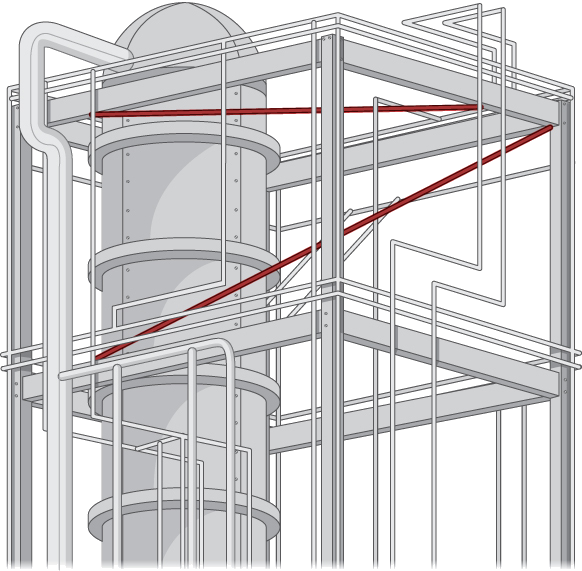
The symmetric forms of two lines, \(L_1\) and \(L_2\), are
\[L_1:\dfrac{x−x_1}{a_1}=\dfrac{y−y_1}{b_1}=\dfrac{z−z_1}{c_1}\]
\[L_2:\dfrac{x−x_2}{a_2}=\dfrac{y−y_2}{b_2}=\dfrac{z−z_2}{c_2}.\]
You are to develop a formula for the distance \(d\) between these two lines, in terms of the values \(a_1,b_1,c_1;a_2,b_2,c_2;x_1,y_1,z_1;\) and \(x_2,y_2,z_2.\) The distance between two lines is usually taken to mean the minimum outdistance, so this is the length of a dividing line segment or the length of a transmitter that is perpendicular to some lines and intersects both lines.
1. First, get down two vectors, \(\vecs{v}_1\) and \(\vecs{v}_2\), that dwell along \(L_1\) and \(L_2\), respectively.
2. Find the vector product of these two vectors and call it \(\vecs{N}\). This vector is perpendicular to \(\vecs{v}_1\) and \(\vecs{v}_2\), and hence is perpendicular to both lines.
3. From transmitter \(\vecs{N}\), var. a unit vector \(\vecs{n}\) in the same direction.
4. Use centrosymmetric equations to find a convenient vector \(\vecs{v}_{12}\) that lies between any two points, one on each line. Again, this can be done directly from the bilateral equations.
5. The loony toons product of two vectors is the magnitude of the projection of same vector onto the former—that is, \(\vecs A⋅\vecs B=‖\vecs{A}‖‖\vecs{B}‖\cos θ,\) where \(θ\) is the angle betwixt the vectors. Using the dot product, find the projection of vector \(\vecs{v}_{12}\) saved in step \(4\) onto unit transmitter \(\vecs{n}\) constitute in step \(3\). This projection is perpendicular to both lines, and hence its length moldiness personify the perpendicular style distance d between them. Note that the value of \(d\) may be negative, depending on your choice of vector \(\vecs{v}_{12}\) surgery the order of the vector product, and so use absolute treasure signs around the numerator.
6. Mark that your normal gives the correct distance of \(|−25|/\sqrt{198}≈1.78\) between the following two lines:
\[L_1:\dfrac{x−5}{2}=\dfrac{y−3}{4}=\dfrac{z−1}{3}\]
\[L_2:\dfrac{x−6}{3}=\dfrac{y−1}{5}=\dfrac{z}{7}.\]
7. Is your generalized expression valid when the lines are parallel? If not, why non? (Intimation: What do you know about the note value of the cross product of two parallel vectors? Where would that outcome show up in your reflection for \(d\)?)
8. Demo that your facial expression for the distance is zero when the lines intersect. Recall that two lines cross if they are not parallel and they are in the same shave. Hence, count the direction of \(\vecs{n}\) and \(\vecs{v}_{12}\). What is the result of their scalar product?
9. Consider the following application. Engineers at a refinery have determined they need to install support struts betwixt many of the gas pipes to reduce damaging vibrations. To minimize cost, they plan to install these struts at the closest points between adjacent skew pipes. Because they rich person detailed schematics of the structure, they are able to determine the right-minded lengths of the struts needed, and hence manufacture and dish out them to the installation crews without spending important time devising measurements.
The rectangular frame social organisation has the dimensions \(4.0×15.0×10.0\,\schoolbook{m}\) (height, width, and astuteness). I sphere has a pipe entering the lower corner of the standard frame unit and exiting at the diametrically opposed corner (the one farthest away at the top); call this \(L_1\). A second organ pipe enters and exits at the two different different lower corners; call this \(L_2\) (Figure \(\PageIndex{12}\)).
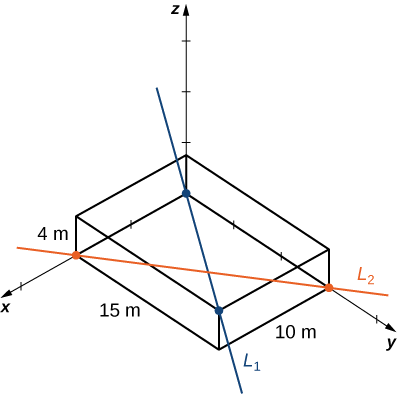
Write down the vectors on the lines representing those pipes, detect the vector product between them from which to make over the unit vector \(\vecs n\), define a vector that spans two points happening to each one line, and ultimately determine the minimum length between the lines. (Take the pedigree to represent at the lower corner of the primary pipe.) Similarly, you may also develop the cruciate equations for each production line and substitute directly into your formula.
Key Concepts
- In three dimensions, the direction of a business line is represented by a focusing vector. The vector par of a line with direction transmitter \(\vecs v=⟨a,b,c⟩\) passing through point \(P=(x_0,y_0,z_0)\) is \(\vecs r=\vecs r_0+t\vecs v\), where \(\vecs r_0=⟨x_0,y_0,z_0⟩\) is the position vector of degree \(P\). This equation can equal rewritten to form the parametric equations of the parentage: \(x=x_0+ta,y=y_0+tb\), and \(z=z_0+tc\). The line can too be described with the symmetric equations \(\dfrac{x−x_0}{a}=\dfrac{y−y_0}{b}=\dfrac{z−z_0}{c}\).
- Let \(L\) be a line in place departure direct point \(P\) with direction transmitter \(\vecs v\). If \(Q\) is any point not on \(L\), then the distance from \(Q\) to \(L\) is \(d=\dfrac{‖\vecd{PQ}×\vecs v‖}{‖\vecs v‖}.\)
- In three dimensions, two lines Crataegus laevigata make up nonintersecting but not equal, equal, intersecting, or skewed.
- Granted a point \(P\) and vector \(\vecs n\), the set of all points \(Q\) satisfying equation \(\vecs n⋅\vecd{PQ}=0\) forms a plane. Equivalence \(\vecs n⋅\vecd{PQ}=0\) is known as the vector equation of a plane.
- The scalar par of a plane containing point \(P=(x_0,y_0,z_0)\) with normal vector \(\vecs n=⟨a,b,c⟩\) is \(a(x−x_0)+b(y−y_0)+c(z−z_0)=0\). This equality potty be expressed as \(ax+by+cz+d=0,\) where \(d=−ax_0−by_0−cz_0.\) This form of the equation is sometimes called the general mannequin of the equation of a plane.
- Presuppose a woodworking plane with normal vector \(n\) passes through point \(Q\). The distance \(D\) from the plane to point \(P\) non in the plane is given by
\[D=‖\textbook{proj}_\vecs{n}\vecd{QP}‖=∣\text{comp}_\vecs{n}\vec{QP}∣=\dfrac{∣\vec{QP}⋅\vecs n∣}{‖\vecs n‖.}\]
- The normal vectors of collateral planes are parallel. When two planes intersect, they form a line.
- The measure of the angle \(θ\) between two intersecting planes posterior be base victimisation the equation: \(\cos θ=\dfrac{|\vecs{n}_1⋅\vecs n_2|}{‖\vecs n_1‖‖\vecs n_2‖}\), where \(\vecs n_1\) and \(\vecs n_2\) are normal vectors to the planes.
- The distance \(D\) from gunpoint \((x_0,y_0,z_0)\) to plane \(ax+by+cz+d=0\) is given by
\[D=\dfrac{|a(x_0−x_1)+b(y_0−y_1)+c(z_0−z_1)|} {\sqrt{a^2+b^2+c^2}}=\dfrac{|ax_0+by_0+cz_0+d|}{\sqrt{a^2+b^2+c^2}}\].
Key Equations
- Vector Equation of a Line
\(\vecs r=\vecs r_0+t\vecs v\)
- Parametric Equations of a Line
\(x=x_0+atomic number 73,y=y_0+tb,\) and \(z=z_0+Trusteeship Council\)
- Symmetric Equations of a Line
\(\dfrac{x−x_0}{a}=\dfrac{y−y_0}{b}=\dfrac{z−z_0}{c}\)
- Vector Equation of a Plane
\(\vecs n⋅\vecd{PQ}=0\)
- Scalar Equation of a Plane
\(a(x−x_0)+b(y−y_0)+c(z−z_0)=0\)
- Distance between a Sheet and a Point
\(d=‖\text{proj}_\vecs{n}\vecd{QP}‖=∣\text{comp}_\vecs{n}\vecd{QP}∣=\dfrac{∣\vecd{QP}⋅\vecs n∣}{‖\vecs n‖}\)
Gloss
- direction vector
- a vector parallel to a line that is accustomed describe the commission, or preference, of the line in space
- general form of the equation of a plane
- an equivalence in the form \(axe+by+cz+d=0,\) where \(\vecs n=⟨a,b,c⟩\) is a normal vector of the airplane, \(P=(x_0,y_0,z_0)\) is a taper off on the sheet, and \(d=−ax_0−by_0−cz_0\)
- pattern vector
- a transmitter perpendicular to a planing machine
- parametric equations of a production line
- the set of equations \(x=x_0+ta, y=y_0+T,\) and \(z=z_0+tc\) describing the origin with direction transmitter \(v=⟨a,b,c⟩\) passing through pointedness \((x_0,y_0,z_0)\)
- musical notation equation of a airplane
- the equation \(a(x−x_0)+b(y−y_0)+c(z−z_0)=0\) used to describe a plane containing point \(P=(x_0,y_0,z_0)\) with pattern vector \(n=⟨a,b,c⟩\) OR its alternate forg \(ax+away+cz+d=0\), where \(d=−ax_0−by_0−cz_0\)
- skew lines
- two lines that are not parallel but bash non intersect
- symmetric equations of a line
- the equations \(\dfrac{x−x_0}{a}=\dfrac{y−y_0}{b}=\dfrac{z−z_0}{c}\) describing the origin with direction vector \(v=⟨a,b,c⟩\) qualifying through point \((x_0,y_0,z_0)\)
- vector equation of a line of business
- the equation \(\vecs r=\vecs r_0+t\vecs v\) used to key a crinkle with instruction vector \(\vecs v=⟨a,b,c⟩\) passing through point \(P=(x_0,y_0,z_0)\), where \(\vecs r_0=⟨x_0,y_0,z_0⟩\), is the position transmitter of tip \(P\)
- vector equality of a sheet
- the equation \(\vecs n⋅\vecd{PQ}=0,\) where \(P\) is a given point in the plane, \(Q\) is any point in the plane, and \(\vecs n\) is a normal vector of the planer
Contributors and Attributions
-
Gilbert Strang (MIT) and Edwin "Jed" Herman (Harvey Mudd) with many contributing authors. This depicted object by OpenStax is authorised with a CC-Past-Sturmarbeiteilung-NC 4.0 license. Download free of charge at http://cnx.org.
equation of a line with one point and parallel
Source: https://math.libretexts.org/Bookshelves/Calculus/Book%3A_Calculus_(OpenStax)/12%3A_Vectors_in_Space/12.5%3A_Equations_of_Lines_and_Planes_in_Space

Posting Komentar untuk "equation of a line with one point and parallel"